
Eukaryotic translation initiation factor 3 subunit F protein art
EIF3F
Proteins of Life by Aster & Sorrel
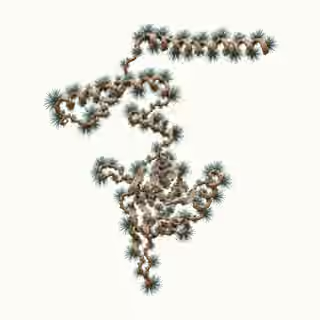
The story behind the protein
EIF3F is a component of eIF3, a complex that helps start protein production. It works with partners to organize the machinery that reads RNA and builds new proteins.
Species: Human (Homo sapiens)
Artwork and molecular reference
Human eIF3f observed translation-initiation subunit region
Label chain B / author I4, entity 2 (Eukaryotic translation initiation factor 3 subunit F): 268 positive target CA at label 90-357. Deposited target mapping: label 1-357 to O00303 1-357. This is an exact deposited target-chain subset in its deposited pose, not a claim to the complete biological assembly. Only the human target eIF3f chain is selected. The MERS-CoV Nsp1 partner, ribosome, RNA, and other initiation-complex components are omitted. All unselected protein chains, nucleic acids, ligands, waters, glycans, tags and non-target fusion regions are omitted.
Structure source: PDB 8PPL
Explore 12 visual styles
- Blue Atlas: Silver-blue foliage and branching botanical forms.
- Paper Garden: Molecular forms interpreted through cut-paper shapes.
- Prussian Blue: A study in deep blue and light.
- Impasto: Painterly texture and expressive color.
- Gilded Grove: A decorative study of molecular form.
- Tidal Dream: A dreamlike interpretation of molecular form.
- Desert Patina: A molecular study inspired by painted relief.
- Tessera: Molecular form interpreted as Roman mosaic.
- Vermilion: A warm vermilion molecular rendering.
- Painted Light: Soft planes of colour, built from quiet brushwork.
- Anatomical Study: Sepia ribbons and fine linework on a parchment ground.
- Scarlet Impression: Vivid vermilion ribbons on a textured ivory ground.
The interactive customizer lets you select a style, frame, mat and size. Framed artwork is made to order. Standard ground shipping within the United States is included.
Art informed by molecular structures. Color, texture and decorative details are artistic choices. These works are for display and general scientific engagement, not diagnosis, treatment or research use.