
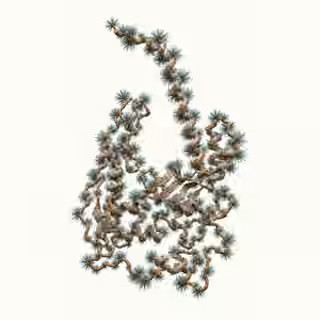
Complement component C9 protein art
C9
Proteins of Life by Aster & Sorrel
The story behind the protein
Complement C9 contributes to the membrane attack complex of the immune system. Assembling this structure opens a pore in a target membrane, helping the body attack susceptible microbes.
Species: Human (Homo sapiens)
Artwork and molecular reference
Human complement C9 observed membrane-attack-complex subunit
Label chain F / author H, entity 6 (Complement component C9): 407 positive target CA at label 39-223, 282-374, 414-542. Deposited target mapping: label 1-559 to P02748 1-559. This is an exact deposited target-chain subset in its deposited pose, not a claim to the complete biological assembly. All unselected protein chains, nucleic acids, ligands, waters, glycans, tags and non-target fusion regions are omitted. Unobserved residues and zero-occupancy coordinates are not reconstructed, interpolated, or copied from another chain. Mapped spans do not imply observed completeness.
Structure source: PDB 8B0G
Explore 12 visual styles
- Blue Atlas: Silver-blue foliage and branching botanical forms.
- Paper Garden: Molecular forms interpreted through cut-paper shapes.
- Prussian Blue: A study in deep blue and light.
- Impasto: Painterly texture and expressive color.
- Gilded Grove: A decorative study of molecular form.
- Tidal Dream: A dreamlike interpretation of molecular form.
- Desert Patina: A molecular study inspired by painted relief.
- Tessera: Molecular form interpreted as Roman mosaic.
- Vermilion: A warm vermilion molecular rendering.
- Painted Light: Soft planes of colour, built from quiet brushwork.
- Anatomical Study: Sepia ribbons and fine linework on a parchment ground.
- Scarlet Impression: Vivid vermilion ribbons on a textured ivory ground.
The interactive customizer lets you select a style, frame, mat and size. Framed artwork is made to order. Standard ground shipping within the United States is included.
Art informed by molecular structures. Color, texture and decorative details are artistic choices. These works are for display and general scientific engagement, not diagnosis, treatment or research use.