
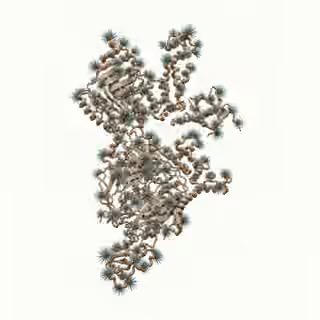
Acetyl-CoA carboxylase 1 protein art
ACACA
Proteins of Life by Aster & Sorrel
The story behind the protein
This enzyme prepares a key ingredient for making fatty acids. It helps cells turn available resources into the fats needed for membranes and storage.
Species: Human (Homo sapiens)
Artwork and molecular reference
Human acetyl-CoA carboxylase-1 deposited core-region dimer
Exact deposited two-chain assembly of the inactive filament core preparation. Chain A has1527 observed target CA positions and B has758; their unequal completeness is retained. Acetyl-CoA and other nonprotein components are omitted. The unobserved N-terminal regions and an extended filament are not reconstructed. Deposited sequence differences are retained and documented. Only positively occupied observed target coordinates are used; unobserved residues, excluded tag/fusion ranges and omitted partners are not reconstructed or interpolated. Coordinate completeness is defined by the per-chain observed and missing ranges, not catalog mapped span.
Structure source: PDB 8XL1
Explore 12 visual styles
- Blue Atlas: Silver-blue foliage and branching botanical forms.
- Paper Garden: Molecular forms interpreted through cut-paper shapes.
- Prussian Blue: A study in deep blue and light.
- Impasto: Painterly texture and expressive color.
- Gilded Grove: A decorative study of molecular form.
- Tidal Dream: A dreamlike interpretation of molecular form.
- Desert Patina: A molecular study inspired by painted relief.
- Tessera: Molecular form interpreted as Roman mosaic.
- Vermilion: A warm vermilion molecular rendering.
- Painted Light: Soft planes of colour, built from quiet brushwork.
- Anatomical Study: Sepia ribbons and fine linework on a parchment ground.
- Scarlet Impression: Vivid vermilion ribbons on a textured ivory ground.
The interactive customizer lets you select a style, frame, mat and size. Framed artwork is made to order. Standard ground shipping within the United States is included.
Art informed by molecular structures. Color, texture and decorative details are artistic choices. These works are for display and general scientific engagement, not diagnosis, treatment or research use.