
NMDA receptor subunit GluN1 protein art
GRIN1
Proteins of Life by Aster & Sorrel
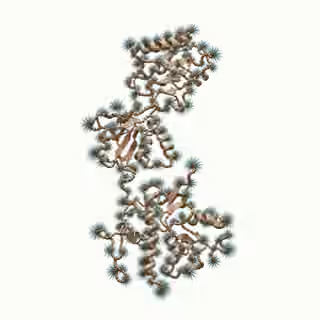
The story behind the protein
This protein is an essential part of a receptor that helps nerve cells respond to the messenger glutamate. Its activity helps connections between cells change with experience, contributing to learning and memory.
Species: Human (Homo sapiens)
Artwork and molecular reference
Human NMDA receptor GluN1 observed subunit
One observed GluN1 subunit is selected from a GluN1/GluN2C receptor. Other receptor subunits and ligands are omitted; this does not depict a complete functional receptor. Deposited sequence conflicts remain documented. Source sequence differences are preserved as deposited. Missing residues, zero-occupancy-only residues, tags, fusion partners and unselected chains are not invented or interpolated. Coordinate completeness is defined by the per-chain observed and missing ranges, not catalog mapped span.
Structure source: PDB 8E92
Explore 12 visual styles
- Blue Atlas: Silver-blue foliage and branching botanical forms.
- Paper Garden: Molecular forms interpreted through cut-paper shapes.
- Prussian Blue: A study in deep blue and light.
- Impasto: Painterly texture and expressive color.
- Gilded Grove: A decorative study of molecular form.
- Tidal Dream: A dreamlike interpretation of molecular form.
- Desert Patina: A molecular study inspired by painted relief.
- Tessera: Molecular form interpreted as Roman mosaic.
- Vermilion: A warm vermilion molecular rendering.
- Painted Light: Soft planes of colour, built from quiet brushwork.
- Anatomical Study: Sepia ribbons and fine linework on a parchment ground.
- Scarlet Impression: Vivid vermilion ribbons on a textured ivory ground.
The interactive customizer lets you select a style, frame, mat and size. Framed artwork is made to order. Standard ground shipping within the United States is included.
Art informed by molecular structures. Color, texture and decorative details are artistic choices. These works are for display and general scientific engagement, not diagnosis, treatment or research use.